
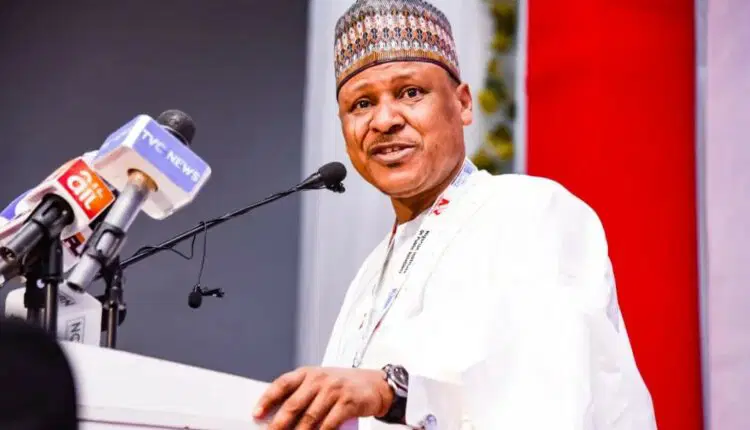
Ahead of the 2027 general elections, the Federal Government has cautioned religious leaders against describing Nigeria’s insecurity as a religious conflict, warning that such narratives could heighten tension, deepen divisions and threaten peaceful coexistence across the country. Minister of Information and National Orientation, Mohammed Idris, issued the warning at the grand finale of the 2026 […]
Ahead of the 2027 general elections, the Federal Government has cautioned religious leaders against describing Nigeria’s insecurity as a religious conflict, warning that such narratives could heighten tension, deepen divisions and threaten peaceful coexistence across the country.
Minister of Information and National Orientation, Mohammed Idris, issued the warning at the grand finale of the 2026 Synod of the Charismatic Bishops Conference of Nigeria and the International Communion of Charismatic Archbishops, Bishops and Apostles in Abuja.
Idris appealed particularly to Christian leaders to use their platforms to promote peace, tolerance, truth and responsible citizenship, insisting that no Nigerian should face threats or discrimination because of their religious beliefs.
The minister argued that the country’s security challenges should not be reduced to a Christian-Muslim confrontation because terrorists and criminal groups have targeted Nigerians from different faiths and backgrounds.
“We should not allow our security challenges to be wrongly presented as a religious war,” Idris said, explaining that the aim of criminal and terrorist groups was to spread fear and weaken national unity.
He reaffirmed the Federal Government’s commitment to protecting religious freedom, noting that the Constitution guarantees Nigerians the right to freely practise their faith. He said Christians, Muslims and followers of other religions should be able to worship and live peacefully without fear of persecution.
On the security situation, Idris said the Tinubu administration had improved intelligence gathering, cooperation among security agencies, military operations and logistics. He added that Nigeria had strengthened partnerships with the United States and other friendly countries in areas including intelligence sharing, counter-terrorism, training, defence and border security.
He disclosed that security forces had maintained pressure on terrorist and criminal networks operating across the North-East, North-West and North-Central regions. According to him, approximately 1,000 terrorist elements, including several of their leaders, were eliminated during the first quarter of 2026.
Idris also highlighted the rescue of 308 abducted Nigerians in Niger and Kwara States in August, describing the operation as a coordinated, intelligence-led effort involving the Armed Forces, DSS and Nigeria Police Force.
Despite these efforts, the minister said lasting security would require cooperation from communities and religious institutions. He urged clerics to help steer young people away from radicalisation and criminality while promoting dialogue as a peaceful way of addressing grievances.
As political activities intensify ahead of 2027, Idris called on religious leaders to distinguish political competition from religious hostility. He said clerics were entitled to their political opinions but should ensure their influence did not contribute to religious, ethnic or regional divisions.
The minister said religious leaders had a major responsibility because millions of Nigerians rely on them for guidance on issues affecting their families, communities and the nation. He urged them to use their pulpits and other communication platforms to fight misinformation, hate speech and intolerance.
Idris finally called on Nigerians to scrutinise the records and programmes of political candidates, vote according to their conscience and accept legitimate election results, stressing that political differences should never become a reason for violence.