
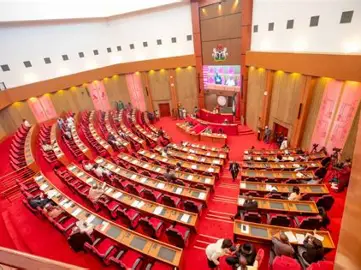
The proposed establishment of state police in Nigeria has moved closer to another legislative milestone, with the National Assembly giving four outstanding state assemblies until November 17 to submit their reports on the constitutional amendment bill. Senate Leader, Opeyemi Bamidele, announced that 32 state Houses of Assembly had already approved the State Police (Constitution Alteration) […]
The proposed establishment of state police in Nigeria has moved closer to another legislative milestone, with the National Assembly giving four outstanding state assemblies until November 17 to submit their reports on the constitutional amendment bill.
Senate Leader, Opeyemi Bamidele, announced that 32 state Houses of Assembly had already approved the State Police (Constitution Alteration) Bill, 2026. He said the remaining four assemblies were expected to submit their reports before the National Assembly resumes sitting.
Bamidele disclosed this in a statement released in Abuja on Sunday after receiving The Sun Senator of the Year Award. Senator Orji Uzor Kalu, founder of The Sun Publishing Limited and Chairman of the South-East Development Commission, presented the award.
The Senate Leader explained that the approvals from 32 state assemblies had satisfied the constitutional threshold stipulated in Section 9(2) of the 1999 Constitution. He described the development as a significant breakthrough in the long-running efforts to restructure Nigeria’s policing system.
He said the National Assembly would not allow the absence of reports from the four remaining states to prevent the process from moving forward. According to him, lawmakers were expected to proceed with the next stage when the National Assembly reconvenes on November 17.
Bamidele also disclosed that the State Police Bill would be transmitted to President Bola Tinubu for assent as part of the next phase of the constitutional amendment process.
The proposed legislation seeks to create a Federal Police Service and State Police Services, introducing a decentralised policing structure in place of the country’s existing centralised arrangement.
The renewed push comes amid continuing security challenges across several parts of Nigeria, where kidnapping, banditry, terrorism and communal violence have remained major concerns. Advocates of state police argue that local security structures could improve responses to threats within communities.
However, critics have expressed concerns that state governors and other political authorities could abuse the system or use security agencies to intimidate opponents. Bamidele insisted that the proposal was not intended to establish ethnic or state armies but community-based policing institutions operating under constitutional safeguards.
He also spoke about the National Assembly’s legislative priorities, citing the Student Loan Act, 2024, and the National Social Investment Programmes Act, 2023, among other laws. He said NELFUND had disbursed more than N204 billion to applicants in colleges, polytechnics and universities.
The Senate Leader further advocated responsible social media engagement, warning against the spread of misinformation and attacks on public institutions. He nevertheless reaffirmed his support for press freedom, an open parliament and continued engagement with journalists.