
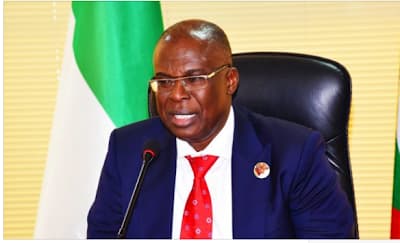
Hours after quitting the APC and accusing the EFCC of acting like an arm of the ruling party, former Bayelsa Governor Timipre Sylva has been challenged to appear before the anti-graft agency over an alleged $14.86m fraud. The EFCC spokesman, Dele Oyewale, issued the challenge on Monday while responding to Sylva’s accusation that the commission […]
Hours after quitting the APC and accusing the EFCC of acting like an arm of the ruling party, former Bayelsa Governor Timipre Sylva has been challenged to appear before the anti-graft agency over an alleged $14.86m fraud.
The EFCC spokesman, Dele Oyewale, issued the challenge on Monday while responding to Sylva’s accusation that the commission had become increasingly political and was being used against him.
“He has been declared wanted; he should make himself available to the commission,” Oyewale said when asked to respond to the former governor’s allegation.
Sylva announced his resignation from the APC on Monday, declaring that he could no longer remain in a party whose leaders, in his view, had abandoned its founding ideals and embraced the belief that “all is fair in politics.”
In his resignation letter, addressed to the APC chairman of Ward 4 in Brass Local Government Area of Bayelsa State, Sylva accused the ruling party of betraying the principles upon which it was established and said the Tinubu administration had disappointed the majority of Nigerians.
The former governor described the APC as a “floundering ship” whose fate appeared to have been sealed by what he called its “irredeemable load of iniquities.”
He also deliberately copied the EFCC in his resignation letter, accusing the commission of conducting itself more like an organ of the APC than an institution of the Nigerian state.
Sylva said he was aware that his action could trigger what he described as a renewed “witch-hunt” against him and his associates, but insisted that he was willing to take the risk.
The former governor’s accusation, however, was followed by a direct response from the EFCC, which reminded him that he had already been declared wanted and should make himself available for questioning.
The commission declared Sylva wanted in November 2025 over an alleged case of conspiracy and dishonest conversion involving $14,859,257. Sylva has denied wrongdoing.
His latest confrontation with the EFCC comes amid a separate legal battle linked to an alleged plot against President Bola Tinubu’s administration. Sylva is listed as a defendant in a 13-count federal charge involving allegations of treason, terrorism-related offences, conspiracy and money laundering.
He has been described as “still at large” in the case, while reports have indicated that he left Nigeria after the alleged plot became public.
Investigators have reportedly accused the former governor of being a principal financier of the alleged operation, alleging that about N785m was contributed through Purple Waves Limited, an Abuja-based company.
More than N5bn was reportedly pooled for the alleged operation, with investigators tracing part of the funds through Purple Waves and a bureau de change operator before the money was allegedly distributed.
Investigators also reportedly linked funds paid into Purple Waves to contracts awarded by the Niger Delta Development Commission and loans obtained by the company.
Sylva has denied involvement in the alleged plot, and the allegations against him remain subject to judicial proceedings. He has not been convicted of any offence arising from the cases.
The legal pressure surrounding the former governor has continued in recent months. In July 2026, the DSS arraigned five of his associates for allegedly concealing his whereabouts after he was declared wanted. They pleaded not guilty and were granted bail.
Earlier, in May 2026, the Federal High Court in Abuja granted an interim forfeiture order covering nine properties linked to Sylva following an application by the EFCC.
Sylva, who served as Bayelsa State governor from 2007 to 2012, later became Minister of State for Petroleum Resources under former President Muhammadu Buhari.
His dramatic exit from the APC has now been followed by a fresh confrontation with the EFCC, placing his political break from the ruling party alongside renewed pressure over the financial allegations for which the commission says he remains wanted.