
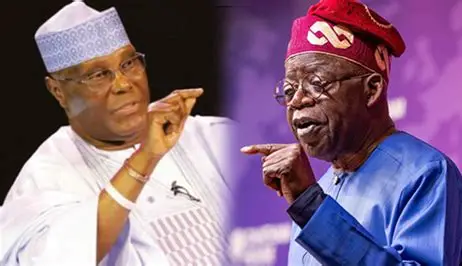
The Presidency has dismissed Atiku Abubakar’s proposed production subsidy on petrol as “economic illiteracy,” insisting that Nigeria’s limited supply of freely available crude oil makes the plan impractical and could expose public finances to the abuses associated with the former subsidy system. Sunday Dare, Special Adviser to President Bola Tinubu on Media and Public Communications, […]
The Presidency has dismissed Atiku Abubakar’s proposed production subsidy on petrol as “economic illiteracy,” insisting that Nigeria’s limited supply of freely available crude oil makes the plan impractical and could expose public finances to the abuses associated with the former subsidy system.
Sunday Dare, Special Adviser to President Bola Tinubu on Media and Public Communications, made the position known in a statement titled *Atiku’s Demagoguery in the Face of Tinubu’s Logical Policies*. He criticised Atiku’s recent comments on the government’s fuel pricing measures, describing them as politically motivated.
Atiku, the African Democratic Congress presidential candidate, had faulted the 30-day petrol discount offered by NNPC Retail and the accompanying price modulation framework. He reportedly described the measures as a “panic-driven gimmick” and accused Tinubu of borrowing from his economic proposals without adopting the production subsidy he considers essential.
Dare countered that Nigeria’s total crude production does not represent the amount available for unrestricted government use. Citing Finance Minister Taiwo Oyedele’s reported estimate, he said the country produces approximately 1.8 million barrels daily but must meet production costs, royalties and contractual obligations before determining the state’s share.
The presidential aide claimed that joint ventures and production-sharing agreements leave the government with fewer than 700,000 barrels per day of unencumbered equity crude. He argued that this limitation makes a broad production subsidy difficult to sustain without creating additional financial and operational risks.
He also warned that such a policy could recreate the opacity, fraudulent round-tripping and public revenue losses associated with Nigeria’s previous petrol subsidy arrangement. The Presidency maintained that any proposal for subsidising fuel production must account for the actual quantity of crude available to the government.
The statement further pointed to the crude requirements of domestic refineries, including the Dangote Petroleum Refinery, arguing that the government could not freely provide all the necessary supplies without affecting existing international agreements. It said this was among the reasons domestic refiners had also imported crude oil.
Dare rejected comparisons between crude oil allocation and agricultural commodities such as garri and cassava, arguing that they failed to account for the realities of international oil markets. He also referenced the United States and Qatar to support the administration’s argument for market-based fuel pricing rather than broad subsidies.
The Presidency maintained that NNPC Retail’s temporary discount was designed to cushion consumers against global crude price increases, not to reinstate the old subsidy regime. Dare said the offer was introduced for Nigeria’s 66th Independence anniversary and later extended for another 30 days.
He also defended the ₦1,350-per-litre ex-gantry price ceiling as a temporary mechanism for absorbing market shocks. Under the framework, refiners and importers would initially bear costs above the ceiling and recover them later when crude prices or exchange-rate conditions improved. The arrangement, according to the statement, would be reviewed monthly using published cost audits.
Other measures highlighted by the Presidency included strategic energy reserves, compressed natural gas expansion, naira-for-crude arrangements, windfall taxes on energy operators and enforcement of the 2025 tax reform laws. Dare also defended subsidy removal and foreign exchange unification, claiming that the reforms had freed funds for allocations to states and local governments.
The statement ended with a rebuke over Atiku’s reported description of Tinubu as a “dull student.” The Presidency defended Tinubu’s academic background and argued that Nigerians should assess the competing economic proposals by their long-term implications rather than what it described as short-term political considerations.