
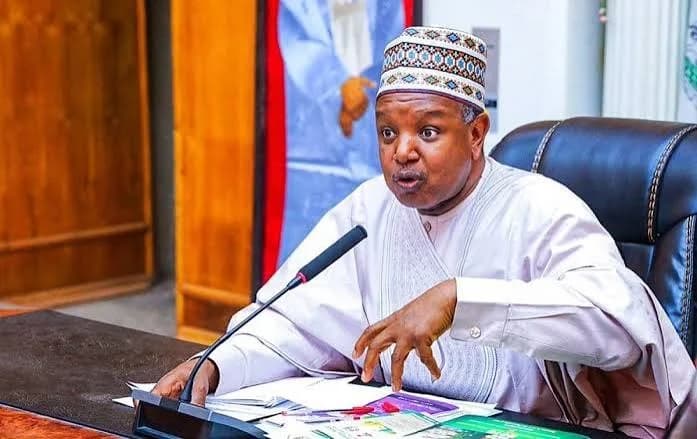
Minister of Budget and Economic Planning, Atiku Bagudu, has called for increased revenue mobilisation and a bigger national budget, warning that Nigeria’s current spending capacity may be inadequate to meet its development needs and achieve its $1tn economy ambition. Bagudu made the remarks on Monday at a capacity-building workshop organised for the Senate Press Corps […]
Minister of Budget and Economic Planning, Atiku Bagudu, has called for increased revenue mobilisation and a bigger national budget, warning that Nigeria’s current spending capacity may be inadequate to meet its development needs and achieve its $1tn economy ambition.
Bagudu made the remarks on Monday at a capacity-building workshop organised for the Senate Press Corps in Abuja, where he argued that Nigeria’s national budget was the smallest among the 10 most populous countries in the world.
He questioned whether the country’s existing budget could adequately address the needs of its population and support its long-term economic ambitions.
The minister said the debate should focus not only on how public funds were spent but also on whether the government was generating enough resources to finance the country’s development priorities.
He urged Nigerians to consider the options for expanding available revenue rather than accepting the current level of public spending without examining whether it was sufficient.
The workshop focused on how legislative oversight and cooperation with the media could help prevent unlawful insertions into the national budget.
Bagudu urged journalists to approach budget reporting with evidence and context, explaining that a provision should not be declared irregular simply because it appears unfamiliar or controversial.
He said reporters needed to examine how allocations originated, why they were included, who stood to benefit and whether they complied with the constitutional budget process.
The minister connected the discussion to President Bola Tinubu’s Renewed Hope Agenda and Agenda 2050, Nigeria’s long-term development framework.
He said the ambition of building a $1tn economy would require the country to address difficult questions about revenue generation, borrowing and the funding of public investment.
Bagudu also stressed that public trust was important to decisions on taxation, expenditure and borrowing, arguing that citizens needed to understand the reasoning behind major fiscal choices.
He reminded participants that the National Assembly had constitutional authority in the budget process and called for greater public understanding of the relationship between the executive and legislature.
Addressing concerns about alleged unlawful budget insertions, the minister warned against drawing conclusions without investigating the provisions in question.
He acknowledged that human error could occur in budget processes but said sustained vigilance by journalists and legislative oversight bodies remained necessary.
Bagudu also called for a balanced approach to transparency, noting that some sensitive information could have implications for national security and strategic interests.
He urged journalists to continue scrutinising public institutions while considering the broader national interest and the development challenges facing the country.
An August analysis by The PUNCH showed that the combined budgets of the 36 states and the FCT rose from N27.22tn in 2025 to N40.14tn in 2026, representing a 47.5 per cent increase.
Despite the increase, capital expenditure declined as a proportion of total state and FCT budgets, dropping from 73.24 per cent in 2025 to 64.34 per cent in 2026.
In actual monetary terms, however, capital allocations rose from N19.94tn to N25.83tn over the same period.
The Federal Government’s 2026 budget was reported at N68.32tn, higher than the combined budgets of the 36 states and the FCT.