
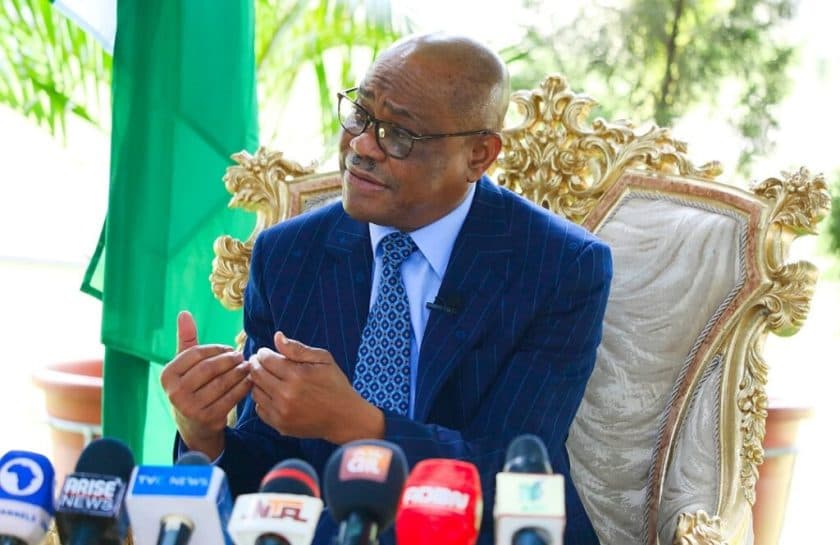
Minister of the Federal Capital Territory, Nyesom Wike, has claimed leadership of President Bola Tinubu’s re-election campaign in the FCT, declaring himself the field commander responsible for coordinating political operations in the territory and Rivers State ahead of the 2027 elections. Wike announced his role on Monday during a stakeholders’ meeting of the Rainbow Coalition […]
Minister of the Federal Capital Territory, Nyesom Wike, has claimed leadership of President Bola Tinubu’s re-election campaign in the FCT, declaring himself the field commander responsible for coordinating political operations in the territory and Rivers State ahead of the 2027 elections.
Wike announced his role on Monday during a stakeholders’ meeting of the Rainbow Coalition in Abuja, where APC and PDP members discussed a joint mobilisation strategy to support Tinubu’s second-term ambition.
The meeting produced an agreement by PDP National Assembly candidates in the FCT to support their APC counterparts. Wike said the coalition would work toward Tinubu’s re-election while helping APC candidates secure victory in the National Assembly contests in the territory.
“For the presidency, all of us have agreed that it is Bola Ahmed Tinubu. I am going to coordinate the FCT and Rivers State. So you can imagine how important it is. I am in charge of the FCT election. I am the commander of field operations as far as the FCT election is concerned,” Wike declared.
He called on the participants to put their political affiliations aside and cooperate for the presidential contest, arguing that the coalition’s objective should take priority over whether members belonged to the APC or PDP.
Wike pointed to the 2024 Edo governorship election as an example of the influence political cooperation could have on an election. He claimed that collaboration between some APC and PDP elements had helped stop the incumbent governor from installing a successor, using the episode to make a case for alliances built around common political interests.
The FCT minister, however, explained that the coalition’s agreement was centred on the presidential election, while the participating parties would decide their positions on other races. The gathering included party chairmen, serving and former senators, National Assembly candidates and political leaders representing the FCT’s six area councils.
Making a case for Tinubu’s return to office, Wike highlighted infrastructure projects and institutional changes in the FCT. These included the establishment of the FCT Civil Service Commission, the appointment of a Head of the Civil Service from the territory’s workforce, and the creation of the Women Affairs and Youth Development Secretariats.
He also mentioned road projects, school renovations, police stations and other public facilities as part of the administration’s record in the territory.
Although he acknowledged the hardship associated with Tinubu’s economic reforms, Wike maintained that difficult measures were needed to address longstanding economic challenges and that their benefits might take time to emerge. He also expressed support for state police as a proposed response to Nigeria’s security challenges.