
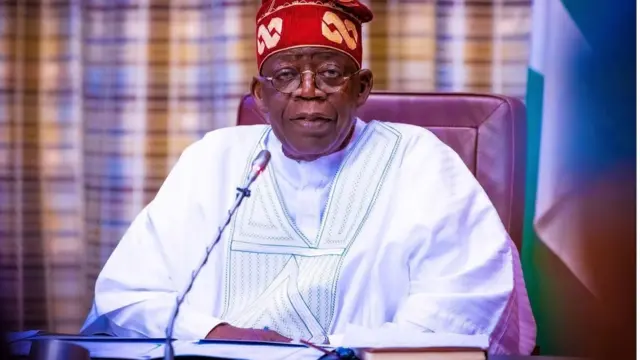
President Bola Tinubu has pointed to a new World Bank report as proof that his economic policies are beginning to deliver results, citing the stabilisation of Nigeria’s poverty rate for the first time since 2019. However, he acknowledged that reducing food prices and creating more employment opportunities remain major hurdles. The President’s position was disclosed […]
President Bola Tinubu has pointed to a new World Bank report as proof that his economic policies are beginning to deliver results, citing the stabilisation of Nigeria’s poverty rate for the first time since 2019. However, he acknowledged that reducing food prices and creating more employment opportunities remain major hurdles.
The President’s position was disclosed in a statement released on Sunday by his Special Adviser on Information and Strategy, Bayo Onanuga, following the publication of the World Bank’s October 2026 Nigeria Development Update.
The report, titled Beyond the Federal Purse: How Higher Revenues Reshaped State Priorities, assessed the effects of Nigeria’s economic reforms on government revenue, state-level spending and economic expansion. Tinubu said its findings indicate that the country’s economy is gaining stability and moving towards sustained growth.
According to the World Bank, Nigeria recorded economic growth of 4.2 per cent in the first half of 2026, up from 3.9 per cent in the same period of 2025, despite disruptions linked to the conflict in the Middle East. The bank projected that the economy could achieve average growth of at least 4.4 per cent between 2026 and 2028.
On inflation, the report showed that the rate dropped from 27.6 per cent in January 2025 to 15.2 per cent by December of the same year. However, rising international fuel prices linked to the Middle East conflict have slowed further progress, with the World Bank forecasting that inflation could fall to around 12 per cent by 2028.
The report also documented an improvement in Nigeria’s external financial position, with the current account surplus reaching $12 billion, equivalent to seven per cent of gross domestic product, in the first half of 2026. The country’s gross external reserves also climbed from $45.5 billion at the end of 2025 to $53.8 billion by the end of August 2026.
The World Bank attributed the increase in government resources partly to reforms implemented since 2023, which helped boost federation revenues by 69 per cent in real terms between 2023 and 2025. State governments reportedly benefited the most, increasing capital expenditure by 151 per cent in real terms, with major investments directed towards transportation, agriculture, energy and housing.
It further revealed that 29 out of 33 states redirected more spending towards economic infrastructure, while real social expenditure per person rose in all but one state. Internally generated revenue increased in real terms in 31 of 35 states, while 21 states lowered their debt-to-GDP ratios between 2021 and 2025. Nigeria’s public debt is also projected to fall from 40 per cent of GDP in 2025 to 38.1 per cent in 2026.
Reacting to the report, Tinubu defended the removal of the petrol subsidy, the unification of the foreign exchange market and measures aimed at improving fiscal discipline. He argued that the policies had strengthened government revenue and created more resources for investment by federal, state and local authorities, although he acknowledged that more efforts were required to improve living conditions for ordinary Nigerians.
“The dividends of reform are becoming visible,” the President said, stressing that the government must ensure the economic gains result in cheaper food and decent employment opportunities for young people. He pledged to sustain the reforms while expanding targeted cash transfers, promoting compressed natural gas, boosting agricultural productivity and improving access to affordable healthcare and quality education.
Tinubu also called on state governments to handle their increased revenue responsibly and concentrate on projects that directly improve citizens’ welfare, particularly in healthcare, education and other essential services. He praised the federal government’s economic management team, state governors and other stakeholders for their cooperation, expressing confidence that his Renewed Hope Agenda 2.0 would speed up the delivery of shared prosperity.