
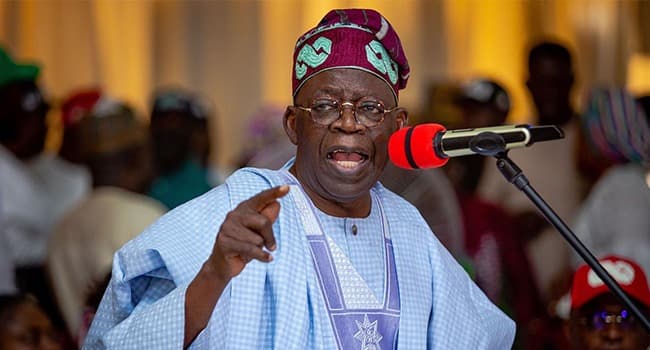
President Bola Tinubu has charged religious leaders to take a stronger stand against terrorism, kidnapping and banditry, urging them to reject attempts to use religion as a justification for violence, cruelty and the killing of innocent people. The President gave the charge in Kano during the Grand Maulud of Sheikh Ahmad Al-Tijani, RTA, with the […]
President Bola Tinubu has charged religious leaders to take a stronger stand against terrorism, kidnapping and banditry, urging them to reject attempts to use religion as a justification for violence, cruelty and the killing of innocent people.
The President gave the charge in Kano during the Grand Maulud of Sheikh Ahmad Al-Tijani, RTA, with the Secretary to the Government of the Federation, Senator George Akume, delivering his goodwill message at the gathering.
Tinubu told the World Khalifa of the Tijjaniyya Order, scholars, spiritual leaders and followers from Nigeria and other countries that religious institutions must become stronger advocates for peace education, religious literacy, scholarship and the proper moral upbringing of young people. He urged spiritual leaders to use their influence to promote justice, compassion and responsibility while encouraging peaceful solutions to legitimate grievances.
The President said religious leaders had a duty to consistently condemn terrorism, kidnapping, banditry and the murder of innocent people, stressing that no genuine act of worship or service to God could justify the destruction of human life. He also urged them to remind political leaders of their responsibilities while discouraging citizens from turning legitimate grievances into excuses for lawlessness and violence.
Tinubu described the timing of the gathering as significant, pointing to the conflicts, insecurity, uncertainty, climate shocks, food and energy crises, violent extremism and transnational crimes confronting societies around the world. He cited a UNHCR report which put the number of forcibly displaced people worldwide at 117.8 million by the end of 2025, saying the situation underscored the growing importance of spiritual leadership.
According to the President, religious leaders can help heal divisions, settle grievances and reduce deeply rooted hatred through their influence within communities. He said the Tijjaniyya, with its extensive networks across West Africa, North Africa and beyond, possesses significant moral influence that can be channelled into reconciliation, countering violent extremism, youth guidance and humanitarian assistance.
Tinubu further stated that the Federal Government would continue to work with religious and traditional leaders to promote tolerance, tackle misinformation and identity-based divisions, strengthen grassroots peacebuilding and encourage peaceful coexistence. He also reaffirmed Nigeria’s commitment to regional cooperation and security, stressing that the country’s strategic position means that instability in Nigeria can have consequences across the wider region.
The President said religious communities with strong international connections could complement the efforts of governments and regional bodies in building an architecture of social peace. He identified truthfulness, compassion, justice, restraint, service and respect for human life as some of the values that should guide such partnerships for the benefit of society.
Tinubu also assured Nigerians that the Federal Government would continue to uphold freedom of worship while deepening cooperation with religious and traditional institutions. He welcomed delegates from Algeria, Morocco, Senegal, Egypt and other countries who attended the Maulud and acknowledged the contribution of the Tijjaniyya tradition to scholarship, spiritual development, service and peaceful community life in Nigeria.
The President paid tribute to the late Sheikh Dahiru Usman Bauchi, whose foundation was involved in organising the Maulud. Tinubu recalled the late scholar’s contributions to Islamic scholarship, moderation, peace and piety, saying his legacy would best be honoured by preserving his commitment to Qur’anic learning, moral instruction, peaceful coexistence and the welfare of society.