
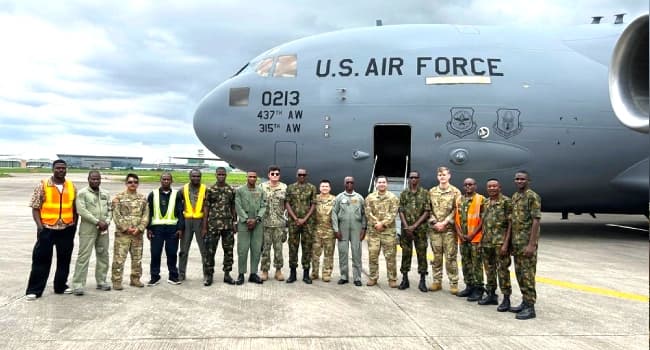
Nigeria’s security partnership with the United States has taken another step forward as Washington delivers military equipment to the Nigerian Air Force, supporting the country’s ongoing efforts to tackle terrorism and other security threats. The equipment was flown into Nigeria aboard a U.S. Air Force C-17 Globemaster III and delivered at military locations in Lagos […]
Nigeria’s security partnership with the United States has taken another step forward as Washington delivers military equipment to the Nigerian Air Force, supporting the country’s ongoing efforts to tackle terrorism and other security threats.
The equipment was flown into Nigeria aboard a U.S. Air Force C-17 Globemaster III and delivered at military locations in Lagos and Kainji, according to the U.S. Africa Command.
AFRICOM said the equipment was supplied under a Foreign Military Sales agreement between Washington and Abuja, describing the delivery as part of efforts to strengthen the bilateral security relationship.
The U.S. command said the assistance would help Nigeria in its counterterrorism operations across the region. It also emphasised that the support was provided at Nigeria’s invitation and would back Nigerian-led operations without undermining the country’s sovereignty.
The nature and scale of the delivery, however, remain undisclosed. AFRICOM has not revealed the specific equipment supplied, the quantity delivered or its estimated financial value.
Visuals released by the U.S. Department of Defense showed the C-17 aircraft and personnel engaged in the process of unloading the equipment in Lagos and Kainji.
The delivery comes shortly after Nigerian and U.S. officials held high-level discussions in Washington on August 13 to assess their security cooperation and determine areas for deeper collaboration.
National Security Adviser Nuhu Ribadu led the Nigerian delegation to the second meeting of the Nigeria-U.S. Joint Working Group, where both sides discussed counterterrorism, intelligence sharing, border security, terrorism financing and military-to-military cooperation.
The officials also considered the protection of vulnerable communities and the situation of internally displaced persons, while Nigeria’s Ministry of Foreign Affairs said the meeting included a review of the countries’ defence roadmap.
The latest military support also follows a broader expansion of counterterrorism cooperation between Nigeria and the United States. In May, AFRICOM said a joint operation with Nigerian authorities in northeastern Nigeria killed Abu-Bilal al-Minuki, whom it identified as ISIS’s director of global operations, along with other senior members of the group.
Further U.S. strikes against ISIS targets were subsequently carried out in northeastern Nigeria in coordination with Abuja, signalling a growing reliance on American intelligence, specialised capabilities and other military support.
The expanding cooperation follows a period of tension between Washington and Abuja over Nigeria’s security situation and religious freedom. The relationship has since shifted toward closer counterterrorism engagement, with Nigeria retaining the lead in military operations while receiving increased support from the United States.